Welcome to Fadi Tohme, New Nephrology Faculty Member

Please welcome Fadi A. Tohme, MD, who joins Washington University School of Medicine as an Assistant Professor of Medicine, with dual appointments in the Division of Nephrology and the Division of Anesthesiology. Dr. Tohme received his medical degree from St. Joseph University (SJU) in Beirut, Lebanon. He completed his residency in internal medicine at the […]

The Surprising Relationship Between BMI and Liver Transplantation Mortality

Many transplant programs decline liver transplantation (LT) to obese candidates because they have a higher risk of surgical complications and death than do non-obese candidates. In addition, obese candidates have longer waiting times for LT. However, studies examining the association of a recipient’s body mass index (BMI) and post LT-mortality have not produced consistent results. […]

On the Road – ASMB Meeting in Nashville

Professor of Medicine Jeffrey Miner and members of his laboratory just spent some quality time together. The group took a road trip to the 2017 American Society for Matrix Biology (ASMB) Workshop on Basement Membranes, held July 12-14 at Vanderbilt University, Nashville, TN. Dr. Miner, Division of Nephrology at Washington University, and Dr. Roy Zent, […]

Surviving Orientation Can Be Murder for First-Year Fellows

A week’s worth of meetings, talks and training conferences were not the only activities on the orientation schedule for the first-year nephrology fellows. The fellows also had to break out of a murder mystery Escape Room. “We always like to promote teamwork and camaraderie among the fellows – so I thought taking them to an […]

Celebrating Hard Work – A Special Thank You

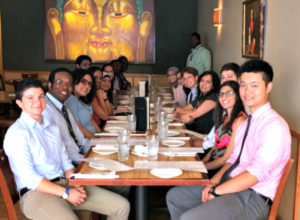
A long-standing tradition in the Division of Nephrology has been to mark the end of consult rotation with the attending treating the fellows, residents, and medical students to a nice meal. “Ever since I was a fellow, the attendings always take the fellows on service, along with the rest of the team members, out for […]

Father-Son Team: Cautious Optimism in the Hunt for Cancer Biomarkers

The search for biomarkers to detect early cases of cancer, track its progression, and monitor therapeutic success is a decades-old odyssey. An article recently published in the journal Trends in Cancer details the advances and hurdles in the development of cancer biomarkers. Andreas Herrlich, Associate Professor of Medicine in the Division of Nephrology, is co-author […]

Please Welcome Our New Nephrology Fellows!

The Division of Nephrology is proud to welcome five new fellows for 2017. We look forward to getting to know each of them in the following months. Fizza Abbas, MD, earned her medical degree from the University of Missouri-Kansas City and completed a residency in Internal Medicine at Barnes Jewish Hospital in St. Louis, Missouri. […]

Dr. Ying (Maggie) Chen Awarded CDI Stem Cell Core Pilot Grant

Ying (Maggie) Chen, Assistant Professor of Medicine in the Division of Nephrology has been awarded a Children’s Discovery Institute (CDI) and Human Pluripotent Stem Cell (HPSC) Core Pilot Grant for her proposal Modeling Tubular Endoplasmic Reticulum Stress-induced Renal Fibrosis using Human Induced Pluripotent Stem Cells. Dr. Chen’s research focuses on the genetic factors responsible for […]

Save the Date: Midwest Transplant Symposium September 8-10

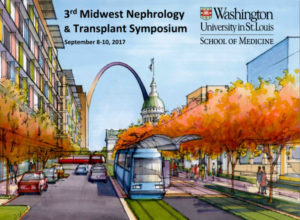
“It is never too late to learn something new!” says Tarek Alhamad, MD, MS, who is Course Chair for the upcoming 3rd Midwest Transplant Symposium on September 8-10, 2017, at Washington University School of Medicine. The symposium is designed for health care professionals including physicians in training, pharmacists, transplant coordinators, surgical assistants, nurses, and nephrologists […]

Personalized Immunosuppression Benefits Low-Risk Kidney Transplants

Kidney transplant rejection rates and renal graft outcomes have dramatically improved over the past 15 years due to the use of antibody induction therapy and calcineurin inhibitors (CNIs). Unfortunately, the potent immunosuppression induced by these drugs increases the risk of malignancies, infections and nephrotoxicity. While current clinical protocols try to reduce CNI exposure, little is […]