“How COVID-19 Changed Social Media in Medical Education”
ASN Online News, August 7, 2026
Authors: Muhammad Yasir Baloch and Muhammad Ulusyar Khan

Muhammad Yasir Baloch, MD, Assistant Professor of Medicine and Director of the Fellowship Outreach and Recruitment at WashU Nephrology, and Muhammad Ulusyar Khan, MBBS, WashU transplant nephrology research fellow, are co-authors of this Kidney News Online editorial examining how social media’s role in medical education accelerated during the COVID‑19 pandemic and has since become a core part of medicine’s educational infrastructure.
The authors describe that while social media was not new to medical education before COVID‑19, the pandemic rapidly expanded its role. As classrooms and conferences moved online, platforms like Twitter, YouTube, and Instagram became central spaces for learning, discussion, and mentorship – a shift that has endured. Learners now expect education to be immediate and accessible, delivered through visual abstracts, infographics, podcasts, short videos, and threaded commentary. Generative AI is accelerating this evolution by reshaping how content is created and shared.
They go on to discuss how nephrology has been especially transformed by this digital growth. Online journal clubs, virtual communities, and creator‑driven formats have made complex physiology and clinical reasoning more approachable. NephJC, NephMadness, GlomCon, and Freely Filtered illustrate how digital nephrology blends real‑time discussion with global, asynchronous learning while broadening who can participate in medical education.
As social media becomes more central to medicine’s educational infrastructure, the authors state that the responsibility now “is to ensure that its reach is matched by rigor, credibility, and educational value.”
Dr. Baloch brings these ideas into practice at WashU Nephrology. He has strengthened the division’s digital presence through strategic social media work, visual content, and emerging AI initiatives. His efforts show how use of digital tools can expand outreach, enhance learning, and support a more connected nephrology community.
Read more about Dr. Baloch here and follow @Myasirbaloch and @ulusyar
on X.
“MANF Clears Mutant Uromodulin in Human Kidney Organoids of Autosomal Dominant Tubulointerstitial Kidney Disease”
Journal of Clinical Investigation, August 25 2026
Authors: Chenjian Gu, Yili Fang, Yixuan Wang, Eric Tycksen, Gayathri Kondepati, Chuang Li, Kendrah O. Kidd, Jun Liu, Fumihiko Urano, Maria Lindahl, Anthony J. Bleyer, Srikanth Singamaneni, Zhao Sun, Ying Maggie Chen
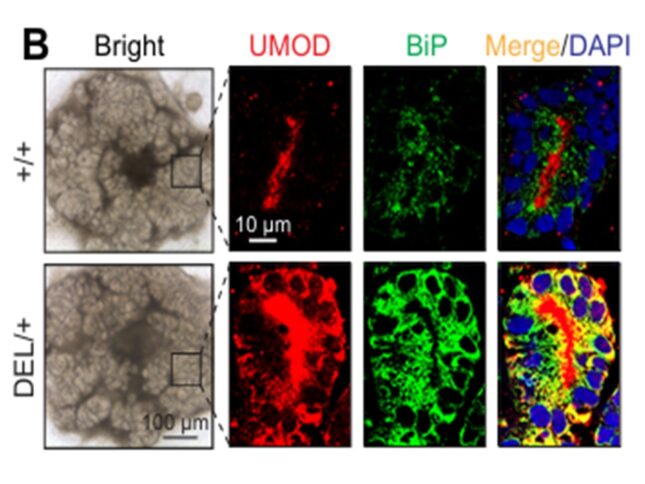
In this JCI Research Letter, co‑first authors Chenjian Gu, PhD, and Yili Fang, MD, PhD -postdoctoral researchers in the Y. Maggie Chen lab – and colleagues used patient‑derived induced pluripotent stem cells to generate human kidney organoids that model autosomal dominant tubulointerstitial kidney disease caused by UMOD mutations (ADTKD‑UMOD). These organoids reproduced hallmark disease features, including ER stress, impaired autophagy, ER calcium leakage, and activation of inflammatory and tubular injury pathways.
The team uncovered a mechanistic cascade in which misfolded UMOD drives IP3R1‑mediated ER calcium efflux, inducing TRIB3 and suppressing AMPK‑dependent autophagy. Overexpression of the ER chaperone MANF reversed these defects by stabilizing ER calcium, reducing TRIB3, restoring AMPK/FOXO3 signaling, and promoting clearance of mutant UMOD. The findings position MANF as a promising therapeutic strategy and establish ADTKD organoids as a powerful human platform for future drug screening. This research was highlighted in the September 5, 2026 edition of ASN In The Loop.
Read more about co-first authors Chenjian Gu, PhD, a 2024 Ben J. Lipps Research Fellow (here), and Yili Fang, MD, PhD, recipient of a 2025 American Heart Association (AHA) Postdoctoral Fellowship (here).
Corresponding author, Maggie Chen, MD, PhD, is a nephrotic syndrome specialist who treats rare, protein-spilling kidney diseases. She directs both the Autosomal Dominant Tubulointerstitial Kidney Disease Center and the Nephrotic Syndrome Clinic at WashU Nephrology, and leads the Y. Maggie Chen Lab.
Dr. Chen recently served as co‑corresponding author with Srikanth Singamaneni, PhD, Lilyan & E. Lisle Hughes Professor, WashU McKelvey School of Engineering, on a minimally invasive diagnostic innovation using a thermostable microneedle patch that rapidly capturing and quantifying kidney biomarkers. This exciting research, “A Thermostable Microneedle Patch for Minimally Invasive Detection and Monitoring of Kidney Dysfunction,” published August 5, 2026, in Advanced Materials (read here), was recently featured in WashU’s The Record and can be read online in The Source, and was highlighted in the September 5, 2026 edition of ASN In The Loop.
“Shared Mechanisms of Organ Fibrosis”
JCI Insight, July 8, 2026
Author: Benjamin D. Humphreys, MD, PhD
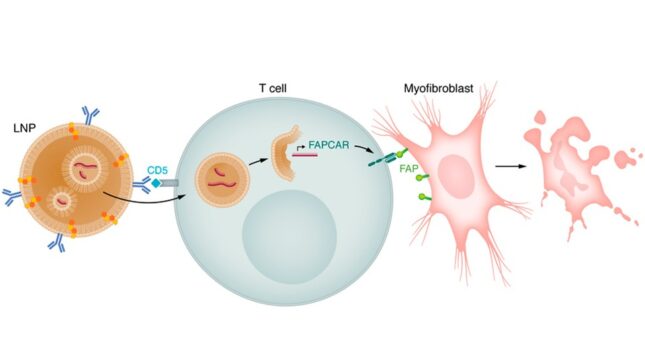
In this JCI Insight review, Benjamin Humphreys, MD, PhD, Joseph Friedman Professor of Renal Diseases in Medicine and Chief of the Division of Nephrology, explores how fibrosis develops across multiple organs through shared cellular and molecular mechanisms.
Fibrosis reflects a complex interplay between diverse cell types and signaling pathways that ultimately leads to the pathologic accumulation of excessive extracellular matrix. Using insights from single‑cell and spatial transcriptomics, Dr. Humphreys describes how fibrosis develops within distinct “fibrotic neighborhoods” composed of injured parenchyma, activated fibroblasts, pericytes, macrophages, and T cells – microenvironments that correlate with disease severity across lung, kidney, liver, and heart. These stressed cell populations lose normal differentiation markers, gain mesenchymal and inflammatory programs, and secrete factors that activate fibroblasts and immune cells, driving progressive extracellular matrix accumulation.
The review also highlights a promising therapeutic direction in fibrosis: chimeric antigen receptor (CAR) T‑cell therapy, originally developed for cancer. Early studies of engineered CAR T cells show encouraging results in reducing fibrosis and improving function in the heart, liver and lung. Newer strategies now allow in vivo generation of CAR T cells using lipid nanoparticles, simplifying treatment and broadening potential clinical use. Together, these advances suggest that immunotherapy may usher in a new era of antifibrotic treatment across multiple organs.
Dr. Humphreys’ research focuses on understanding the cellular and molecular mechanisms of kidney injury and repair, with the goal of developing stem cell–based therapies for chronic kidney disease. His lab uses advanced single-cell and spatial transcriptomic technologies to map kidney regeneration and fibrosis, identifying new therapeutic targets for patients with acute and chronic kidney injury.
Learn more about Humphreys’ groundbreaking research at the Humphreys Lab website. Follow @HumphreysLab on X.
“How I Treat Thrombotic Microangiopathy in the Setting of Triggers“
Blood, July 22, 2026
Authors: Anjua Java, MD, Meera Sridharan, Spero R. Cataland
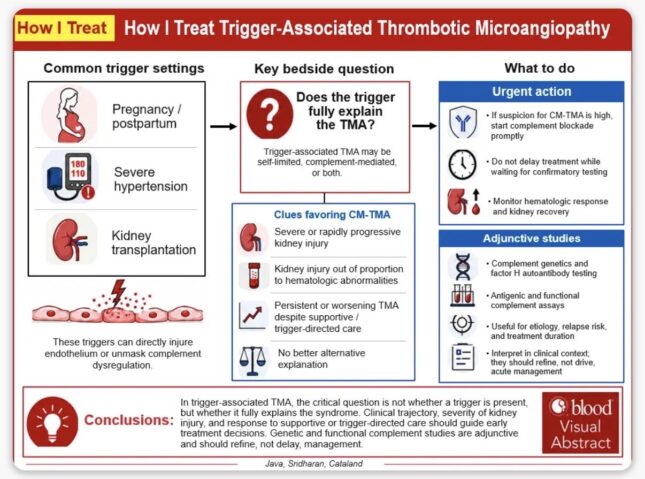
Transplant nephrologist Anuja Java, MD, associate professor of medicine at WashU Nephrology and Director of Kidney Transplant at the John Cochran VA Medical Center, is first author of this How I Treat article in Blood, a series featuring expert opinions and treatment strategies for various hematological conditions.
Complement-mediated thrombotic microangiopathy can be difficult to recognize when it presents in the setting of an apparent clinical trigger, such as pregnancy, severe hypertension, or kidney transplantation. These conditions can each cause direct endothelial injury but may also unmask complement dysregulation in susceptible individuals.
In these situations, the key question is not whether a trigger exists, but whether it fully explains the syndrome – and whether urgent complement blockade is warranted to prevent irreversible kidney injury. Three real-world cases illustrate how the authors approach this decision in practice. In each scenario, the central question is determining whether complement dysregulation is the primary driver or a secondary amplifier within the broader endothelial injury process. The authors emphasize practical bedside reasoning rather than rigid algorithms and show how early recognition of complement-mediated injury directly affects kidney outcomes. The utility and limitations of genetic, antigenic, and functional studies are discussed. (A PDF of the article can be found here.)
Dr. Java’s research focuses on defining the functional impact of genetic variants in complement‑mediated diseases to guide individualized transplant decision‑making. She co‑chairs the NIH‑funded ClinGen complement gene curation expert panel and leads the transplant subcommittee for the National VA advisory board. Her clinical interests center on post‑transplant care, particularly for patients at risk of recurrent glomerular disease.
Read more about Dr. Java here and follow @anuja_java on X.