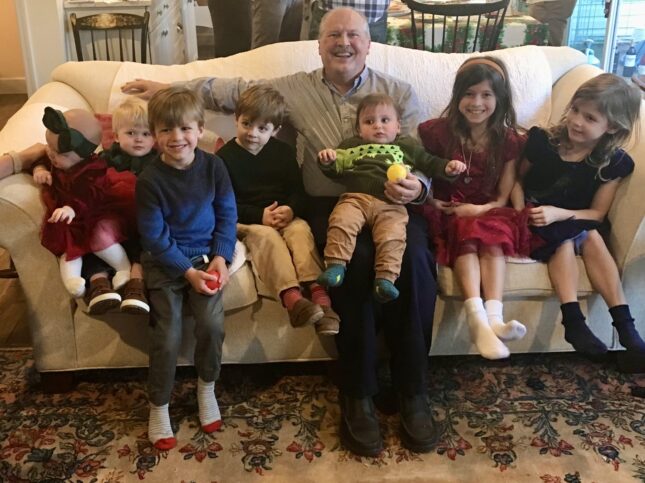
Professor of Medicine, WashU Nephrology
Nephrology Fellow, 1986-1989
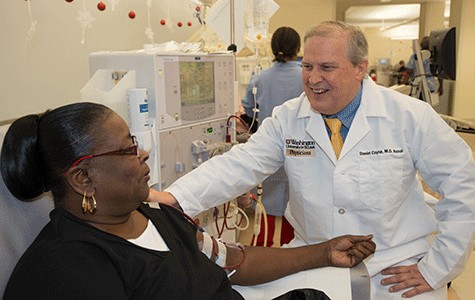
After 32 years on the faculty of WashU Nephrology, Daniel Coyne, MD, is hanging up his stethoscope and heading into retirement. The beloved nephrologist has served as the Medical Director of the Chromalloy American Kidney Center (CAKC) and the Medical Multispecialty Clinic in the Center for Advanced Medicine. And for many of our alumni, he is a revered mentor, having served as the Director of our Nephrology Fellowship Program from 1999-2007.
“I also was a fellow here and I was surrounded by top residents, fellows and faculty during my training,” recalls Dr. Coyne. “They are among the most stellar people I’ve met in medicine. All were very accessible and had an infectious love of science and teaching.” He also worked in the lab of Dr. Aubrey Morrison, who taught Dr. Coyne “a great deal of science, and also how to read scientific literature and think critically and independently.” He says, “I saw master lectures by the likes of Eduardo Slatopolsky, Saulo Klahr, Keith Hruska, and others.”
He joined the faculty after completing his fellowship and worked as an attending physician in the CAKC before being lured to his birthplace of Ohio to take a position as an assistant professor at Case Western Reserve School of Medicine (where he also earned his medical degree). Three years later, though, he returned to WashU.
“I wanted to focus on clinical care in academia, and Dr. Marc Hammerman offered me a position and gave me great latitude to help manage the CAKC and reorganize clinical services as our patient load expanded. I noted huge opportunities to expand our clinical practice, but it was Dr. Hammerman and Dr. Steven Miller who developed the business plan that is still paying dividends for the Division.”
Along with clinical responsibilities, Dr. Coyne began researching anemia and renal bone disease, both commonly seen in patients with chronic kidney disease. He says he began to question prevailing dogma, thanks in part to Dr. Morrison’s training. “Within eight years, I was writing commentaries for JAMA and JASN on the use and abuse of epoetin in dialysis patients,” he says. “Modern management has curved to my views, and that’s better for patients.”
He also conducted dialysis research with Dr. Slatopolsky, noting, “Here I was being taught and guided by an international expert weekly!” Dr. Coyne’s most impactful research was in the field of anemia. In a clinical trial called DRIVE, researchers showed that administering intravenous iron to anemic hemodialysis patients could greatly decrease the need for epoetin. Subsequent trials validated the danger of epoetin, and the safety of iron therapy in CKD patients.
Now stepping down from responsibilities in stages, he has halted his research activities, and has been working part-time since January 2024. He formally retired from the Division at the end of 2025.
He and his wife plan to enjoy more time with their nine grandchildren. He has become quite the gardener — he calls them “gardening challenges” to overcome at his home and lake property. He looks back at his time and his training at WashU fondly. “Dr. Steven Cheng and now Dr. Seth Goldberg have built a fellowship program second to none, recruiting incredibly bright and positive fellows to our program. Any resident interested in Nephrology should aspire to be here at WashU.”